

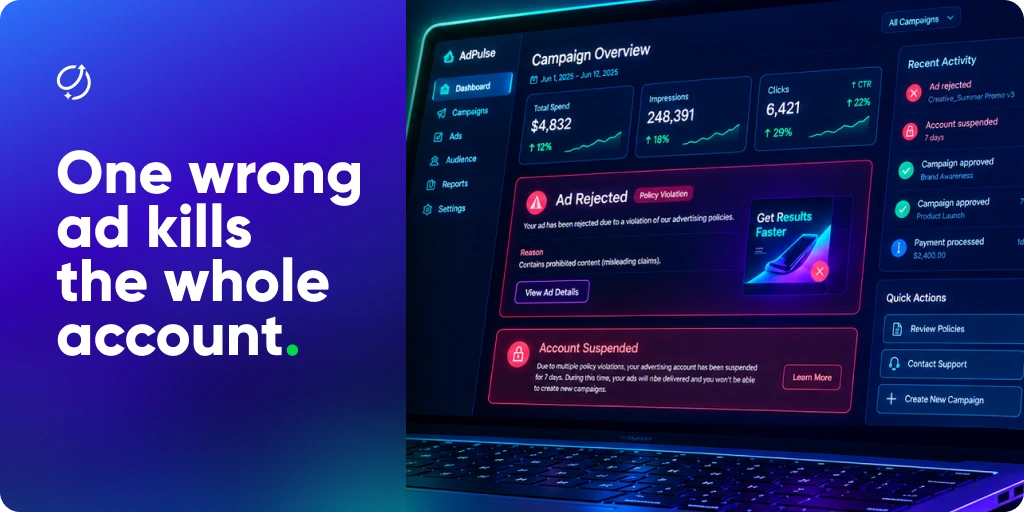
Running paid media as a B2C iGaming operator is a compliance exercise first and a media buying exercise second.
You cannot separate the two. A campaign that ignores platform certification or skips responsible gambling disclaimers does not just risk rejection. It risks losing the account, losing the domain’s certification history, and in markets with active regulatory enforcement, inviting scrutiny from the licensing authority itself. The platforms know what you are. You declared it. Now every campaign you run operates inside that declaration.
What follows is a platform by platform read of what is actually allowed in 2026, how regulated and offshore acquisition differ in practice, and where operators consistently run into problems that the surface level guidance does not prepare them for.

Why Operators Have No Hiding Room on the Major Platforms
A B2C operator acquiring depositing players cannot run campaigns that avoid gambling classification. The product is gambling. The destination is a gambling site. The target audience is potential players. Every major platform knows this, and the certification, licensing, and compliance requirements that follow are the price of entry into any mainstream paid channel.
This is the fundamental difference between operator and supplier paid media in this industry. A B2B supplier can, with careful attention to copy and landing page structure, stay invisible to the gambling classification system. A B2C operator cannot and should not try. The compliance path exists to protect operators as much as it restricts them: certified, licensed advertisers with clean policy health have a stable, defensible channel. Operators that try to run gambling acquisition through uncertified accounts lose those accounts faster and with less recourse.
Build the compliance infrastructure before building the campaigns. The certification paperwork, the documentation per market, the responsible gambling creative standards, all of it needs to be in place and verified before a single campaign goes live.
Google Ads: Certification Is an Ongoing Governance System, Not a One-Time Task
As of 2026, Google allows gambling ads in 55 countries, but each has unique requirements around licensing, age verification, and responsible gambling messaging. The platform now requires separate certifications for different gambling verticals, and each certification is tied to a specific website, meaning a single certification cannot be used across multiple domains.
As of March 23, 2026, Google updated its certification requirements so that all accounts seeking to advertise in any gambling and games category must now demonstrate good policy health. Manager accounts with a significant volume of gambling certificates revoked from accounts under their management, or accounts found to have violated gambling policy while relying on a certificate, lose the ability to apply for any new gambling certifications.
The key operational realities for B2C operators running Google campaigns:
- One domain, one market, one application: An operator with three brands targeting five markets needs fifteen separate certifications, each tied to that domain’s licensing status in that specific jurisdiction.
- Falsified documentation means permanent suspension: Google conducts verification checks, and falsified certifications result in permanent platform bans. Related accounts may also face permanent suspension, and new accounts automatically suspend if linked to previous violations.
- MCC account risk is shared: Operators working under agency-managed accounts need to know that policy violations across other advertisers in the same MCC can affect their own certification eligibility. This is a structural risk most operators do not account for when choosing an agency.
- Domain ownership is now mandatory: Certification is not available for sites hosted on free platforms, those using a subdomain whose root domain is a third party platform host, or those with a second-level domain not owned and operated by the advertiser.
- Social casino and real money gambling need separate treatment: Google requires separate certifications for each gambling vertical, including real-money gambling, social casinos, and sports betting.
The simplest way to think about 2026 gambling advertising on Google is to stop treating certification as a one-time event and start treating it as an ongoing governance system: a current license register, named owners for policy monitoring, a domain ownership record, regular landing page reviews, documented asset approval standards, and a clear escalation process when Google flags an issue.

For iGaming Marketing Teams Who Want More
Practical tips, trends, strategies, and more.
Meta: Prior Written Permission, Per Market, Per Account
On July 9, 2025, Meta announced updated policies requiring any entity wishing to promote gambling-related content to first seek authorization through the Permissions and Verifications portal in Business Suite. Advertisers must provide proof of their legal status, including their business name, website, and relevant gaming licenses, before applications can be reviewed.
Approvals are now tied to specific Business Managers and ad accounts rather than sitting at the advertiser level. Meta tightened enforcement further in 2026: on February 23, 2026, it banned social casino and free-to-play gambling-style ads in 19 markets, including India, Indonesia, the Philippines, Thailand, and Vietnam.
What this means operationally:
- A multi-brand operator needs a separate application for each brand, each territory, and each significant change to URL structure or licensing status.
- The application process includes declaring whether you are an operator, affiliate, or aggregator. Facebook’s manual review process can take several weeks for initial applications, during which time Meta’s compliance teams review documentation, verify licenses, and assess business legitimacy.
- Fast budget increases, weak account health, and mismatched landing pages can lead to rejection or delivery limits. Increasing a single ad set’s budget by more than 20% per day may trigger a manual review, and for gambling advertisers already under tighter scrutiny, scaling too hard and too fast can turn a working campaign into a compliance problem almost overnight.
- The July 2025 update introduced a two-tier system for influencer and creator involvement. Where a gambling operator runs an ad and only tags a creator, no further permission is needed for the creator. However, where a creator runs a gambling ad themselves, they must register as a formal affiliate with Meta, receive Meta’s permission for their account, and sign a contract confirming the commercial relationship with the licensed operator.
When permissions are in place and targeting is clean, Meta’s demographic and behavioral data makes it a workable channel for brand awareness and reactivation campaigns. Responsible gambling messaging in creative is not optional. The operators consistently approved and performing on Meta are the ones whose ads include helpline links and age restriction language as standard.
Creative Compliance: What You Can and Cannot Say
Platform certification gets you in the door. Creative compliance keeps you there. Across every regulated market, the direction on what operators can say in gambling ads has moved consistently toward restriction.
The non-negotiable baseline across platforms and markets:
- Licensing authority must be visible, either in the ad or on the landing page.
- Age restrictions must be stated explicitly (18+, 21+, or higher depending on jurisdiction).
- Responsible gambling resources and helpline links must be present and functional.
- Language implying financial gain, urgency to deposit, or guaranteed outcomes is prohibited on every platform and in most regulatory markets.
- Bonus terms must be presented accurately and prominently. Language that obscures wagering requirements is flagged for review across multiple markets.
Beyond the baseline, markets diverge significantly:
- Italy: Since 2018, Italy has enforced a near-total ban on gambling advertising under the Decreto Dignità, covering virtually all forms of promotional communication, both online and offline. Licensed operators are required to allocate an amount equal to 0.2% of their net revenues annually to responsible gambling campaigns, up to a maximum of €1 million, as a condition of holding a license. The advertising ban remains active as of 2026, with the government reviewing options for a controlled return of advertising, but no confirmed timeline.
- Netherlands: From July 1, 2023, under the Orka Decree, untargeted gambling advertising was banned, including ads on radio, TV, in newspapers, and in public spaces. From January 1, 2024, it became illegal for gambling companies to sponsor television programmes and events. On July 1, 2025, a total ban on sports sponsorship came into effect. As of 2026, the government is moving toward an almost total ban after operators were found exploiting loopholes through targeted online advertising and social media.
- Germany: Under the Interstate Treaty 2021, operators no longer need separate advertising permits, but the framework imposes strict watershed restrictions (6am to 9pm) on virtual slot and online poker advertising, alongside restrictions on affiliate advertising including a ban on revenue-share remuneration models.
- Sweden: Swedish authorities evaluate gambling marketing on the basis of moderation, focusing on tone, placement, and frequency of adverts. New guidelines effective September 2025 require that all bonus terms be visible at first glance and accessible no more than one click away online, and that all gambling marketing is exclusively aimed at adult audiences.
An operator running pan-European campaigns needs creative that survives the strictest market’s restrictions, and a routing layer that localizes copy, channels, and timing per jurisdiction.

What Nobody Tells You About Account Health and Enforcement
Here is the part most paid media guides skip entirely. Staying close to responsible gambling standards in creative, beyond just the minimum required, is a prerequisite for long-term account health across all platforms. It does not, however, protect against enforcement sweeps or unexpected account actions. Even compliant accounts get caught from time to time.
What compliance history does is give you a recovery path. An operator with a clean compliance track record, documented processes, and a history of responsible creative has a credible appeal when something goes wrong. An operator who has been testing the edges of what the platform allows tends to find that the same enforcement action is much harder to reverse.
Paddy Power is the clearest example of what deliberate brand strategy looks like in a highly regulated environment. Campaigns aim to provoke and generate earned media coverage. Its 2019 “Loyalty is Dead” campaign featuring Rhodri Giggs never uttered the words “sports,” “betting,” or “casino” once during the entire ad. It was a deliberate creative choice designed to rely entirely on brand association. While the campaign was ultimately banned by the UK’s Advertising Standards Authority (ASA) for glamourising a wealthy lifestyle, its execution demonstrates the sophistication level tight markets demand: brand association and cultural relevance doing the heavy lifting when product messaging is completely restricted.
Some regulated operators do test harder-edged creative and treat resulting flags as acceptable collateral. There is documented evidence of operators creating one-off controversial ads specifically because they have no plans to reuse them, making it harder for regulators to take sustained action against single-run campaigns. In the UK specifically, fines from the UKGC represent a calculated cost for some large operators: the campaign reach and brand uplift outweighs the regulatory penalty. That is a strategic calculation large, well-capitalised operators with clean compliance history make. It is not a model for operators still building that foundation.
The Affiliate Compliance Burden: Where the Real Friction Lives
Affiliates remain the dominant player acquisition channel for B2C operators in most markets, and the compliance burden on affiliate programs has grown sharply alongside the channel’s scale.
Germany and several Nordic markets represent the sharpest pressure points right now. Under Germany’s Interstate Treaty, there is far-reaching liability for operators that employ affiliates. A gambling operator is expected to ensure that its affiliates respect relevant marketing requirements, since any infringements could trigger interdiction letters and competition law claims against the operator directly. Critically, the Interstate Treaty prohibits variable remuneration for advertising on the internet, meaning revenue, deposit, or stakes-based remuneration models are not permitted. Only flat, pre-agreed fixed fees such as pay-per-click or fixed-per-registration models remain compliant.
The German regulator GGL has transformed into an aggressive enforcement agency. By mid-2025, it was actively monitoring 858 German-language gambling websites, with 212 hosting illegal content. Affiliate marketers have become a primary enforcement target, with cease-and-desist orders and fines reaching up to €50,000 for promoting unlicensed operators or violating advertising restrictions.
In Sweden, any use of affiliates must acknowledge the marketing restrictions, including the prohibition on direct marketing toward players who have registered for self-exclusion. In terms of liability, affiliates are subject to restrictions on illegal aiding and abetting of unlicensed gambling and have a responsibility to verify that the necessary licences are held by the operators they promote. Spelinspektionen stepped up action against the promotion of unlicensed gambling in the second half of 2025, handling nine supervisory cases involving publishers, influencers, and payment intermediaries. In December 2025, a Swedish court sentenced an influencer to two years and nine months in prison for multiple offences, including gross promotion of unlawful gambling.
The practical implication for operators: affiliate contracts, payment structures, and monitoring processes need to be built around the strictest market in your portfolio, not the most permissive. Bonus hunter traffic, players who deposit only for promotions and generate negative lifetime value, remains a structural problem for affiliate programs built around welcome offer promotion. Operators who do not segment by behavioral quality from day one tend to discover the problem much later in the LTV cycle, when the cost has already compounded.
Influencer and Streaming Channels: Distribution Matters More Than the Stream Itself
Influencer and streamer partnerships remain one of the more effective player acquisition channels for B2C operators, particularly for casino and sportsbook brands targeting younger adult demographics. The compliance environment around these channels has tightened sharply across every platform.
Platform by platform:
- YouTube: It permits gambling content in licensed markets with age gating and affiliate disclosure. Direct CTAs linking to operator sites with urgency language are flagged more aggressively than educational or entertainment-led content.
- Twitch: The platform prohibits streaming of any websites containing slots, roulette, or dice games that are unlicensed in the US or other jurisdictions with consumer protections such as deposit limits, waiting periods, and age verification systems. Twitch also prohibits sharing links and referral codes to gambling sites, a policy that predates the streaming restrictions and applies regardless of the operator’s licensing status.
- Kick: The platform was built partly as a response to Twitch’s restrictions, with founders including Stake.com backers. Kick requires streamers to be located in jurisdictions where online gambling is legal, and prohibits gambling funded by viewer contributions. It currently offers more tolerance for gambling content than Twitch, but platform rules in this space shift quickly.
- X: It is worth watching as a channel. Gambling content tolerance is higher than on most mainstream platforms and community building around operators and betting discussion happens organically there.
- Discord: This platform has been a meaningful community channel for crypto-native operators, though Telegram is increasingly taking over that role as the preferred closed-community platform for gambling audiences.
- Reddit: It remains underused for reputation building in regulated markets. Genuine, transparent participation in relevant communities builds the kind of organic credibility that paid placements cannot manufacture.
The most important insight about streaming, and the one most operators miss: streaming success is not driven primarily by the stream itself. It is driven by the short-form content distributed across multiple channels that funnels people toward long-form streams and communities. An operator investing in a streaming partnership without a distribution strategy for the content being produced is funding awareness that dissipates rather than compounds.
Offshore and Crypto Operators: A Different Game Entirely
Everything above applies to licensed operators in regulated markets. Offshore operators and crypto casinos work from a fundamentally different channel stack, and the two playbooks have almost nothing in common.
Offshore and crypto-native operators cannot access Google Ads certification, Meta’s permission process, or mainstream programmatic inventory, because they operate in markets and under license structures those platforms do not recognize. The channels that actually work for this segment are:
- Third-party Telegram advertising networks. The official Telegram Ads platform prohibits gambling, betting, casinos, and related content, with such ads frequently rejected and accounts at risk of being banned. However, third-party Telegram ad formats, such as those provided by networks like RichAds, do not impose the same restrictions, allowing operators and affiliates to run gambling and iGaming campaigns through Mini Apps inside Telegram. These ads appear inside Telegram games and bots, with formats including push-style banners, interstitial video, playable ads, and embedded banners. The distinction between official Telegram Ads (prohibited) and third-party network placements inside the Mini Apps ecosystem (available, but not guaranteed stable) matters: treat this as a performance channel that requires monitoring, not a permanent infrastructure.
- Crypto native ad networks. Networks built specifically for Web3 and crypto audiences offer display, native, and push formats with gambling category access that mainstream networks restrict. Audience quality is uneven and requires close monitoring, but for operators targeting crypto-native players the match is significantly better than general programmatic inventory.
- Push and pop networks. Networks like RichAds and PropellerAds specialize in high-volume player acquisition through push notifications, pop-unders, and native formats. These are pure performance channels tuned for fast conversion funnels, measured by deposit rate and first session value rather than brand metrics.
- X, Reddit, and community channels. For crypto casino brands, genuine participation in relevant communities on X and Reddit builds organic trust that paid placements cannot replicate. Hard promotional posts get buried. Authentic contribution, answering questions, being transparent about the platform, sharing real outcomes, drives acquisition at lower cost and higher long-term retention than volume-focused paid spend.
One thing that runs through all of it: in crypto and offshore markets, the operators building sustainable businesses compete on product, community, and trust. Bonus hunters do not build a brand. Volume comes after market reputation is built, not before. The operators who reverse that sequence tend to run high acquisition spend against players who churn quickly, which is a math problem that compounds badly over time.
What This Means for B2B Suppliers
Understanding how operators run paid acquisition in both regulated and unregulated contexts is commercially useful for any B2B supplier in this industry. When a compliance officer or a CMO is evaluating a new vendor, they are doing it from inside a specific set of paid media constraints that shape their priorities and their risk tolerance.
A supplier who understands Germany’s ban on revenue-share affiliate remuneration, the implications of the Netherlands moving toward a near-total advertising ban, or the specific documentation an operator now has to submit to Meta for each market they enter is having a fundamentally different conversation than one pitching generic product benefits. That fluency is a trust signal before a contract is ever discussed, and it is the kind of signal that shortens evaluation cycles in a relationship-driven market. Paid media only works when the rest of the visibility stack holds it up.