

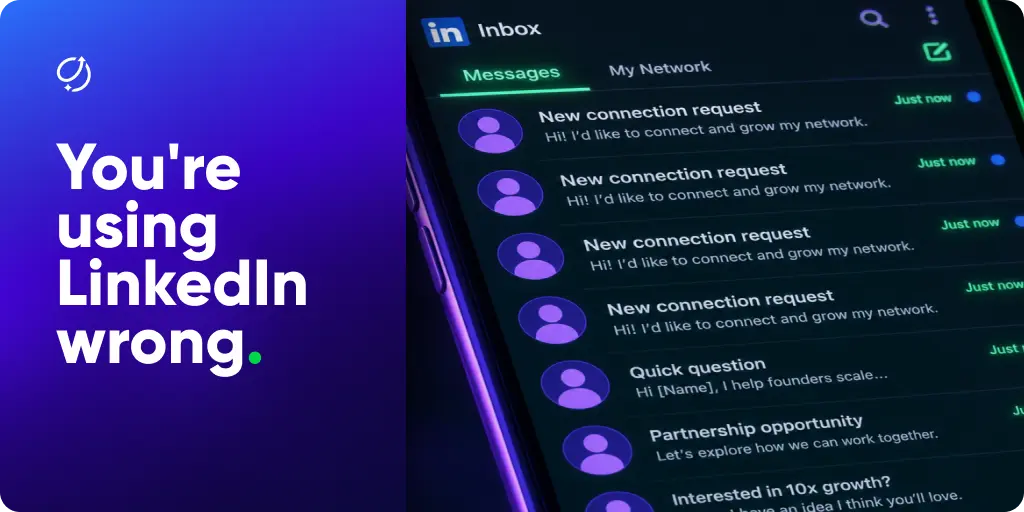
Your inbox probably looks like this. Three connection requests before 10 AM. One from a payment provider. One from a platform company. One from someone whose entire message is a copy-paste pitch ending with “would love to connect and explore synergies.”
Surprised to read this article’s title? You might be thinking LinkedIn is already unbearable. Overrun with sales pitches and award selfies and announcements nobody asked for. You are not wrong about the problem. You are wrong about the conclusion.
There is a real difference between using LinkedIn blindly for outreach and annoying everyone in the room, and using everything the platform offers to make it an actual sales and trust engine. This playbook does the latter.

The Real Problem Is Not LinkedIn. It Is How iGaming Brands Treat It.
Ask any senior decision maker at an operator what their LinkedIn inbox looks like and you will hear the same word: exhausting.
The messages follow a pattern so predictable it has become a running joke at SiGMA and ICE.
- Someone connects.
- Three days later, a pitch arrives with a company overview attached.
- No reply? A follow-up: “Just wanted to bump this to the top of your inbox.”
- Still nothing? A third message: “I know you are busy.”
- Sequence expires. The same rep tries again six months later with no memory of the previous attempt.
Most of this comes down to one thing. Nobody did the research.
Sales and outreach teams in iGaming run the same generic targeting and the same generic message at everyone on a list. The role does not match the message. The market context does not match the pitch. Often the person being contacted is not even the right decision maker at all, just a name that fits a filter. That single gap, no research before the first message, is the most common reason outreach fails in this industry, and it shapes everything else in this piece.
This is not a LinkedIn problem. It is a volume-over-relationship problem, and iGaming has it worse than most B2B industries for one specific reason.
The buyer pool is smaller than it looks.
Globally, the regulated operator universe sits somewhere in the thousands. But for most B2B providers, the realistic active list, the operators they would actually want to do business with right now, rarely runs past a couple thousand names, and often far fewer. Every platform company, game studio, payments processor, KYC vendor, and affiliate tech firm is circling roughly the same names. When you run automated outreach at that pool repeatedly, you are not just failing to generate pipeline. You are teaching those operators exactly who you are, before you ever have a real conversation.

For iGaming Marketing Teams Who Want More
Practical tips, trends, strategies, and more.
The iGaming brands winning on LinkedIn are not posting more. They are not automating more. They are picking their spots, building real visibility before they ever reach out, and using the platform the way it was designed: as a long game, not a short-cycle prospecting tool.
Why Your Company Page Is the Smallest Part of This
iGaming companies treat their LinkedIn company page as a broadcast channel.
New game launch? Post. Award win? Post. SiGMA recap with booth photos? Post.
The page accumulates followers mostly from employees and existing partners, engagement stays low, and the marketing team reports “reach” as the metric without anyone asking what it actually produced.
Here is the reality: on its own, a company page rarely moves pipeline in this industry. But that does not mean the page is wasted, it means it is underused. Done right, it can do far more.
What moves trust in iGaming is the same thing that has always moved trust in iGaming. People.
The operators who sign platform deals are not signing them with company pages. They are signing with people they have been watching for months. People who showed up at the same events. Who said something worth reading on a regulation change in a new market. Who gave an honest take on a product trend without trying to sell anything.
Personal brand is not optional in this industry. It is how credibility is actually built. LinkedIn is where that credibility is now visible between the events.
The shift looks like this:
- Your company page supports.
- Your people lead.
- And both still need to protect your core positioning.
iGaming LinkedIn is full of informal content. Event photos, team celebrations, casual takes, behind-the-scenes moments. None of that needs to come at the cost of your messaging. A company page can be relaxed and human while still reinforcing what you stand for and what makes you different. The mistake is not posting informal content. The mistake is letting the page drift so far from your positioning that nobody can tell what you actually do or why you do it differently.
What Founder and Executive Visibility Actually Looks Like in iGaming
This is not about motivational content or thought leadership for its own sake. Nobody in iGaming needs that.
The operators and commercial decision makers on LinkedIn are there for one of two reasons: they are looking for intelligence, or they are building relationships. The best executives in this space serve both at once.
The data behind this is no longer ambiguous. The 2024 Edelman-LinkedIn B2B Thought Leadership Impact Report found that 9 in 10 decision-makers and C-suite executives are more likely to be receptive to outreach from companies that consistently produce high-quality thought leadership. Not the brand’s content. The individual’s. That distinction matters more than most marketing teams want to admit.
LinkedIn’s own research puts a further number on this: 82% of B2B marketers who work with creators say influencer campaigns are essential to measurable ROI, and 56% of B2B buyers rely on practitioner input specifically during the final stage of the buying process.
This is also why LinkedIn just launched Creator Marketplace, currently in alpha and rolling out to selected brands, embedded directly inside Campaign Manager. Marketers can now search for B2B creators by topic, review verified audience demographics and engagement data, and reach out for partnerships without leaving the ad environment. LinkedIn building an entire product around individual experts is not a coincidence. It is the platform confirming in product form what buyer behavior has been showing for years: practitioners carry more weight in B2B buying journeys than corporate brand content alone.
For B2B iGaming brands, the immediate implication is not to go find external creators to partner with. It is to recognize that the experts already inside your company are the asset most brands are underusing. The brands that keep acting as the sole messenger, pushing everything through a company page, will fall behind the ones that build visibility through their people.
This matters especially because 40% to 60% of B2B deals end in no decision, according to a Harvard Business Review study across more than 2.5 million sales conversations. Not because the buyer chose a competitor, but because they never gained enough confidence to move at all. In iGaming, where platform decisions involve compliance, product, tech, and commercial stakeholders all moving at different speeds, that confidence gap is wider and harder to close than in most B2B categories. Practitioner-led content is one of the few things that closes it before a sales conversation ever begins.
Executive visibility works in iGaming when the person behind the profile clearly knows the industry from the inside. Consider what actually earns attention here:
- A CPO posting about a specific challenge in a newly regulated market, drawing from what they saw play out in a previous entry, not what they read in a report.
- A founder sharing a candid view on what smaller operators actually need from a platform deal, and what they almost never get.
- A payments veteran giving their real read on settlement delays in new jurisdictions, without packaging it as a product pitch.
There is also a simple north star for choosing what to talk about: go where the market is already heading. Right now that means prediction markets and crypto casinos. The executives who show up early and consistently on the topics the industry is moving toward are the ones who get remembered as the people who saw it coming.
When content looks like that, compliance officers at operators add that person to a mental shortlist before a single sales call happens.
The iGaming brands doing this well post two to three times a week on topics they genuinely own. Regulatory shifts. Product decisions. Market entry realities. Commercial structures. Not trend roundups. Real insight that could only come from someone who has been in the room.
The company page reposts it. The sales team references it in outreach. The whole thing compounds into trust that no ad budget can replicate.
| Expert insight: LinkedIn’s move to productize creator discovery is the platform admitting what B2B buyers already know. Individual expertise builds trust faster than brand content, and in iGaming, trust is what moves deals. |
The Post-Event Window Most iGaming Brands Waste Entirely
If there is one mistake that costs B2B iGaming companies more pipeline than almost anything else, it is this.
They go to ICE, SiGMA, or SBC. They have 40 meetings in three days. The booth comes down, the recap post goes up within 48 hours, it collects some likes from colleagues and a few comments from other exhibitors, and the whole thing fades before the month is out.
Meanwhile, every operator they met is back at their desk, working through notes from the floor, comparing conversations, rebuilding shortlists. The evaluation window is wide open.
To be fair, this is not always laziness. A few brands have started waking up to this and move fast, which gives them a real edge while most of the industry is still catching up. For everyone else, the reasons are human and predictable:
- Everyone comes home exhausted and wants to recover before doing anything else.
- Their own leads and to-do lists take priority. The people they met are dealing with the exact same backlog.
- Post-event overwhelm is real, and different people handle it differently, usually by doing nothing for a week.
- Nobody prepared proposal templates or usable notes in advance, so follow-up turns into a slow scramble instead of something that goes out the next morning.
Here is what the post-event content window actually looks like when it is used properly:
- Days 1 to 3: Warm connection requests referencing a specific conversation, not a generic “great to meet you at ICE.”
- Days 4 to 10: Content that speaks directly to the themes your floor conversations kept returning to. If three separate operators asked you about a specific integration challenge, write something about it. Publicly. That post reaches the operators who had the same question but did not make it to your stand.
- Weeks 2 to 6: Follow-up content that keeps your perspective visible without any pitch. Market observations. Regulatory updates relevant to the markets your buyers are entering. Honest takes on what you heard on the floor.
- Week 6 onward: This is where warm outreach actually lands. You have been visible since the event. You have said something useful at least four times since the handshake. The message does not feel cold because you have not been cold.
A no-reply at any point in this window does not mean no interest. More often it means the other person is buried, not uninterested. Brands that win are the ones who keep the momentum going anyway, with follow-up that adds value each time rather than just checking in.
The events are not the pipeline moment. The weeks after the event are. iGaming brands often treat the debrief as the end. The ones ruling the game treat it as the starting gun. And if you are still relying on events alone for visibility, events without a LinkedIn follow-up strategy are a sunk cost.
The LinkedIn Features Your Competitors Are Ignoring
LinkedIn has evolved well beyond a feed of posts and a DM inbox. The features that drive the most value for B2B iGaming brands are the ones used least. Here is an honest breakdown.
Sales Navigator: The Operator Targeting Tool Nobody Is Using Properly
Almost every iGaming commercial team already has a Sales Navigator. The tool is not the gap. How it gets used is.
Most teams treat it as a glorified contact list. Used properly, it lets your sales and marketing teams:
- Build a named account list: every tier-one and tier-two operator you want to reach, segmented by geography, growth stage, or the markets they are entering.
- Track buying signals in real time: a new compliance hire at an operator often signals a pending market expansion. A new CTO is often the beginning of a platform review. Job changes are not just noise, they are intent signals.
- See who is already engaging: with your content or your team’s profiles before you ever reach out, turning what would be a cold message into a warm one.
- Map the buying group: in iGaming, a platform deal involves commercial, product, tech, and compliance. Sales Navigator lets you identify and track all four, not just the one person who replied to a connection request.
The signals are already there for any team willing to look at them properly. The gap purely comes down to intent. And for teams ready to go further, LinkedIn and ABM used together is where the real pipeline is built.
LinkedIn Newsletters and Articles: Owning a Topic Before the RFP
Every major iGaming trade outlet publishes content that operators read. CalvinAyre. iGB. SBC News. The smart play is not to compete with those. It is to occupy a niche they cannot own: your specific expertise, your specific market, your specific point of view on the problems your buyers are trying to solve.
Most decision makers will not engage publicly or read religiously. There is too much noise. But content that speaks directly to their pain or their goals still gets consumed quietly, even when nobody likes or comments. Many leaders watch everything relevant to them without ever showing it.
Consistency is what turns that quiet consumption into positioning. Say the same thing, in the same lane, often enough, and you become the name people associate with it. The catch is that real leaders can tell the difference between actual expertise and regurgitated content from a mile away, so this only works if what you publish is genuinely yours.
LinkedIn Newsletters and Pulse articles add one more advantage that is becoming harder to ignore. They are increasingly picked up by AI tools and search systems as source material, which means consistent, well-written Pulse content can show up in the answers operators get when they ask an AI tool about your category, not just in their feed. In regulated markets especially, this feeds your brand’s trust signals far beyond LinkedIn itself.
What works here:
- A regulatory watch from a compliance-forward provider, published every time a major jurisdiction update lands.
- A commercial operations newsletter written for tier-two operators navigating their first major market expansion.
- A technical deep-dive series aimed at CTOs evaluating platform architecture decisions, covering the questions vendors never answer publicly.
LinkedIn Ads: The Retargeting Play Most iGaming Marketers Skip
iGaming brands either do not run LinkedIn ads at all or run brand awareness campaigns with no targeting logic behind them. There is a third option that almost nobody uses.
Retargeting people who have already engaged with your content is one of the most efficient uses of LinkedIn’s ad inventory, particularly in a small market like iGaming where every impression on the right person is worth more than a thousand impressions on the wrong one.
The play looks like this:
- Someone views your founder’s post about market entry complexity. They do not comment. They scroll on. LinkedIn knows they saw it.
- Two weeks later, your Thought Leader Ad, featuring your CPO’s follow-up piece on the same topic, surfaces in their feed. They are now seeing you twice on a subject they care about.
- The third touch is a piece of case study content, retargeted specifically to accounts that have visited your website.
By the time your sales team reaches out, that operator-side decision maker has seen your thinking three times on a subject they are actively working through. The outreach does not feel cold, because it is not.
| Expert insight: Thought Leader Ads, which promote content posted by a named individual rather than a company page, consistently outperform standard sponsored posts in industries where trust is personal. |
The Comment Strategy That Outperforms Most Posting Schedules
This is not a new idea. Plenty of people in B2B circles have talked about the value of strategic commenting for years. What is new is how badly most iGaming brands still execute it.
A well-placed comment on the right post does more for your visibility than ten posts on your own profile, and it still works exactly the way it always has.
In iGaming, where the same senior decision makers are active on LinkedIn at any given time, commenting strategically on the content those people post, or the content that surfaces in their feeds, gets you noticed before you ever need to reach out.
This is not about leaving generic compliments or emoji reactions. Those get ignored, and decision makers can spot them instantly. It is about:
- Adding a contrarian point of view that invites a reply from the original poster.
- Sharing a specific example from your own market experience that extends the conversation in a useful direction.
- Asking a sharp question that the post did not answer, one that signals you understand the topic at a level the original poster respects.
When a CPO at a tier-one operator sees your comment on a regulatory post and it is the most thoughtful thing in the thread, you have just earned a profile visit without asking for one. That profile visit, if your profile is built properly, turns into a connection request from them to you.
That is the direction of trust you want. Let them come to you first.
The real problem is consistency, not awareness.
Most leaders know this works. The issue is that it gets handed to a junior who has no context to comment with real authority, or worse, run through automated tools that post generic replies. Both approaches do more damage than good, because the entire value of a comment comes from showing that a real, knowledgeable person paid attention.
The honest reason this falls apart is priorities. When a leader has to choose between putting out a business fire and spending half an hour on LinkedIn, the fire wins almost every time. That is understandable, but it is also why the people who do protect that half hour daily build a visible edge that compounds month after month.
There is no shortcut here. The thirty minutes has to be genuinely spent reading and responding as yourself. What can help is making that time easier to protect:
- Block it on the calendar like any other meeting.
- Keep a running list of posts and people worth engaging with so you are not starting cold each day.
- Treat it as a non-negotiable part of the commercial role, not something that happens if time allows.
The Outreach That Actually Gets Replies in This Industry
So you have built visibility. You have posted consistently. You have been in the right comment threads for two months. Now what?
The message you send matters enormously, and the iGaming context makes it more specific than most LinkedIn guides will tell you.
Here is the first thing to accept. The person you are messaging already knows you are reaching out for business. Pretending otherwise, or dressing it up as something else, insults their intelligence. Being direct about why you are reaching out is not the problem. Being generic, salesy, or trying to be clever about it is.
What kills the reply before it happens:
- Opening with your company name and what you do. They already checked your profile. You are wasting the first sentence.
- Referencing a generic stat about the iGaming market to establish relevance. Every other vendor does this. It signals nothing.
- Asking for a call in the first message. In an industry where relationships are built over event cycles and long sales conversations, asking for 30 minutes from a cold message signals you do not understand how this business works.
What actually gets a reply:
- Referencing something specific. A post they wrote, a market they recently entered, a panel they spoke on, something that required you to pay attention to them specifically.
- Making the first message about something useful to them, not something convenient for you.
- Creating a reason to continue the conversation that does not require a calendar invite. A question about their experience, a piece of content directly relevant to something they mentioned publicly, an observation about the market they are entering.
The goal of the first message in iGaming is not a meeting. The goal is a reply. One reply from the right operator-side decision maker is the beginning of the relationship cycle that eventually produces a meeting, which eventually produces a deal. Skipping straight to the ask collapses that cycle before it starts.
One more thing that damages real conversations. The moment someone replies and a conversation actually starts, take them out of every automated sequence they were ever part of. Nothing kills a warming relationship faster than the same person getting a generic follow-up campaign message from a colleague while they are mid-conversation with you. From that point on, every next step should build on what has already been said, not on what a sequence says should happen next.
Be human and likeable, not smart or salesy. Nobody enjoys being pitched. Add value, be transparent about why you are there, and let the relationship do the rest.
How to Turn Profile Views Into Pipeline
iGaming professionals get a handful of profile views after an event or after a post performs well, glance at the notifications, and do nothing with them.
That is a real miss.
A profile view in this industry, especially from someone at an operator you are actively targeting, is a soft signal of interest. They did not reach out. But they looked. Here is how to use that:
- If they are in your target account list: Send a connection request referencing something specific, a post you both engaged with, a shared connection, the market context they operate in. Do not mention that you saw they viewed your profile. Just make contact at the right moment.
- If they are a new name: Research them before anything else. Understand their role, their market, what they have posted recently, whether they are a commercial decision maker or an influencer within a buying committee. Then decide whether to connect and how.
- If they visited after a specific piece of content: Your next move is a follow-up post on the same topic, not an outreach message. If they visited because your market entry piece resonated, publish the next piece in that thread. They are already watching.
This is also where segmentation and lead scoring earn their place. Not every profile view, comment, or connection deserves the same response. Someone from a tier-one operator who has engaged three times in a month sits in a very different bucket than someone who viewed your profile once and disappeared. Mapping engagement against account priority and role lets you decide who gets personal outreach now, who goes into a warm nurture list, and who gets tracked for the next few months. Without that mapping, even good signals end up treated the same as noise.
Profile views are breadcrumbs. The brands that follow them thoughtfully, and prioritize them correctly, are the ones whose outreach never feels like outreach.
The LinkedIn Funnel Nobody in iGaming Has Built Yet
Here is the honest gap in this industry. Almost every B2B iGaming brand treats LinkedIn as a single-layer activity. You post. You get engagement. You reach out. You hope.
What almost no one has built is an intentional funnel where every LinkedIn feature has a specific job at a specific stage.
It looks like this:
Awareness stage:
- Founder and executive posts building category visibility on the topics your buyers care about.
- Company page amplification of those posts, without losing core positioning in the process.
- LinkedIn articles and Pulse content targeting the search behavior of operators researching your category, and increasingly, what AI tools surface when operators ask about it.
Consideration stage:
- LinkedIn Newsletter delivering consistent expertise directly to subscribers who opted in.
- Retargeted ads served to accounts that have already engaged, with ad type matched to where the account sits. Thought Leader Ads for trust-building, document or carousel ads for educational depth, conversation ads for accounts ready to take a next step.
- Sales Navigator tracking buying signals across your named account list.
Pipeline stage:
- Warm outreach that references real engagement and real context, not a cold connection sequence.
- Comment-based relationship building with the specific people in a buying committee, before anyone reaches out directly.
- Content timed to event windows and market triggers, not a generic editorial calendar.
The honest truth about LinkedIn Ads is that almost nobody in iGaming runs them well. Even the rare brands doing something decent are usually under-running them, not enough volume, and not matched to where the account actually is in the journey. Ads are not a single tool for brand visibility. They are a set of tools, each suited to a different stage, and most of the funnel above stays empty because nobody is using them that way.
None of this requires a large team. It requires a clear strategy and the discipline to treat LinkedIn as a revenue channel, not a content channel.
