

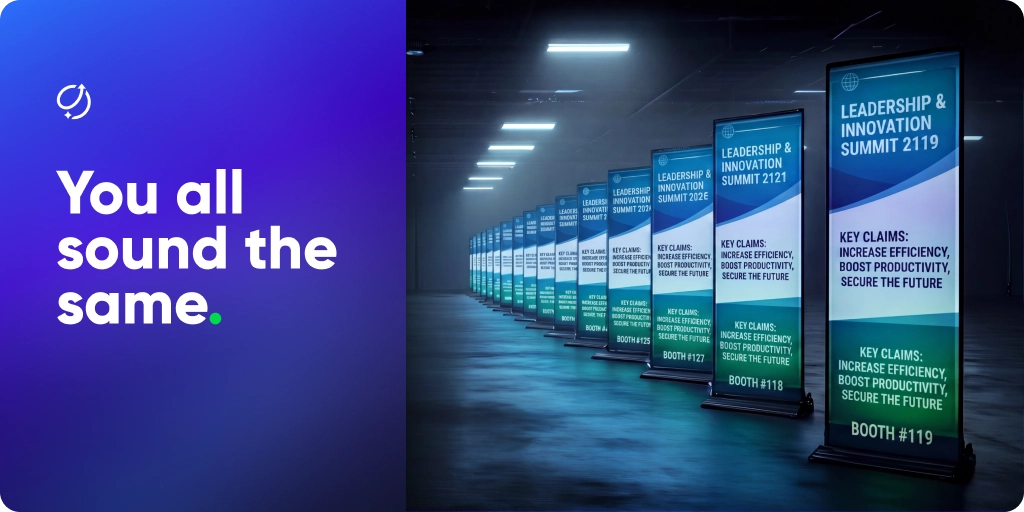
Read the pull-up banners at any major iGaming event. Fastest time to market. Best RTP. Seamless integration. Award-winning platform. Certified across 40 jurisdictions.
Now step back and try to recall whose banner said what.
You cannot. Neither can the operators, studios, and procurement leads these brands spent six figures to reach.
The iGaming market has become highly saturated, with rising competition and commoditization making differentiation increasingly difficult. In that environment, perception and trust have become the deciding factors, not product specs. The brands that understand this are pulling away. The brands still competing on feature lists are running faster to stay in the same place.
This piece is about how to stop doing that.

The B2B iGaming Sameness Problem Is Structural
The homogeneity in this market did not happen because brands are lazy. It happened because the category matured fast and the natural tendency under competitive pressure is to match what the market leader says, add one more claim, and call it differentiation.
Every game studio now claims the best mechanics. Every platform provider claims the fastest launch. Every aggregator claims the widest reach. Every PAM vendor leads with scalability and compliance. These claims are often true. They are also indistinguishable, which makes them commercially useless.
Only 52% of organizations have a clearly defined value proposition that truly sets them apart from competitors, and in iGaming, it is much higher. Most providers are still selling against a checklist of licensing, RTP, and integration speed, the same three things every buyer has already heard from five other vendors before lunch. Vendor selection cycles run long and buying committees run wide, so that gap compounds. It is the reason deals stall at evaluation, relationships plateau after the first contract, and cost of acquisition keeps climbing even as brand visibility improves.
The decision-maker sitting across from you has heard “fastest time to market” enough times that the phrase stopped registering around the third vendor. At that point, the vendor who wins is almost never the one with the longest feature list. It is the one whose story arrived with the most precision.
Positioning Lives Upstream of Everything
Positioning is the answer to one question: in a world where the buyer has ten options that look nearly identical, why does choosing you feel like the only logical decision?

For iGaming Marketing Teams Who Want More
Practical tips, trends, strategies, and more.
Most brands treat positioning as a messaging exercise. They refresh the website hero copy, run a rebrand, or update the sales deck. These are expressions of positioning. They are not positioning itself.
Real positioning starts upstream, with three things most brands skip:
- What exists in the market and where the genuine gaps are, not assumed gaps but the ones that show up in buyer conversations, lost deals, and support tickets.
- What the buyer’s ideal outcome looks like when everything goes right. Not what your product does, but what changes for them after they chose you.
- Where your product or service owns ground that no direct competitor has claimed and can credibly hold.
When those three answers are clear, messaging almost writes itself. When they are not, no amount of brand investment covers the gap.
The Four Positioning Moves That Actually Work
Category Definition: Name the Problem Before Anyone Else Does
The most durable positioning in B2B iGaming comes from brands that do not compete for an existing category. They define a new one.
The mechanism is straightforward. You identify a problem the market is experiencing, one that buyers feel acutely but have not yet articulated cleanly, and you name it. Once you name it, you own the conversation around it. Every operator or platform who recognizes that problem now associates the solution with you before any competitor gets to open their mouth.
One operator-facing example makes this concrete. The “crypto-native casino” positioning that some B2C operators adopted in the mid-2020s was not about adding a Bitcoin payment method. It was about naming an entire approach to a specific type of player and building everything around that identity. Product decisions, affiliate partnerships, UX, support language, all of it followed from the positioning. The operators that did this well did not compete with traditional casino brands. They made that comparison irrelevant.
The B2B parallel exists everywhere in this market. A provider that positions itself as the infrastructure that quietly determines whether a casino survives year three has defined a category around a different type of urgency than “fastest integration.” One of those conversations starts at the product evaluation stage. The other starts at the board level.
Audience Specificity: The Narrower You Go, the More You Are Heard
Generic positioning is the default in this market. Specific positioning is rare. Rare things get noticed.
Most B2B iGaming brands speak to “operators” as though that is a single coherent audience. A tier-1 operator running a licensed product in a saturated Western European market has almost nothing in common with a startup operator entering their first regulated emerging market. Their fears differ. Their timelines differ. Their internal stakeholders differ. What counts as a successful vendor relationship looks completely different to each of them.
When you narrow your positioning to a specific audience type and speak directly to their situation, something shifts in the buyer’s experience. They feel understood rather than pitched. In a market full of identical claims, feeling genuinely understood is a competitive advantage most brands walk straight past.
The concern that specificity excludes potential customers is understandable but largely misplaced. In practice, specific positioning attracts the accounts that convert and filters out the ones that consume sales resources without closing. That is not a smaller market. That is a better one.
Outcome-Based Positioning: Sell the After, Not the What
Features describe what your product does. Outcomes describe what the buyer’s world looks like after they chose you.
These are entirely different conversations, and buyers only care about one of them.
“Best RTP” is a feature claim. “Operators running our content see measurable session length uplift within the first quarter, with specific examples from comparable market entries” is an outcome with evidence. One is a vendor assertion. The other is a result the buyer is already trying to achieve. In a procurement review where a CFO has been added to the buying committee, only one of those lands.
Outcome-based positioning requires knowing what the buyer is actually trying to solve. A tier-2 operator expanding into a new regulated market is not simply looking for a platform provider. They are trying to avoid the exact mistakes that cost comparable operators a year of delayed revenue during a previous migration. They want to open on schedule, with a compliant product, without burning their internal tech team on integration problems that should have been resolved before go-live. Every piece of your positioning, your sales materials, your case studies, and your event presence should speak to that outcome by name.
Layering: When the Core Product Is Similar, Build Adjacent Angles
Sometimes the market is crowded enough that the core proposition, however strong, needs reinforcement from a different direction. This is not a positioning failure. It is a maturity signal. The brands that understand it build something competitors cannot easily copy.
Consider what Alea did with employer branding and workplace culture at a point when their core product competed in a crowded space. The positioning around a genuinely positive working environment was not a distraction from product marketing. It became a differentiator in talent acquisition, partnership conversations, and client perception simultaneously. The brand became known for something adjacent to the product that competitors were not competing on, and that adjacency strengthened everything else. (They have since shifted their positioning, but the period when that angle was central to their brand is a genuine case study in how to layer.)
The principle holds beyond that example. When your core offering is strong but not unique enough on its own, find the angle that no competitor is owning and build it with the same conviction you brought to the product.
The Brands That Win Pick One Thing and Hold It
The brands that own a clear position in this market did not get there through better creative. They got there by choosing something specific and refusing to let go of it.
Take what happened in the African iGaming market. When generic European content providers tried to port their existing libraries across, the results were predictable. Players and operators were getting reskinned versions of global hits, not games built for them. Black Lagoon Games saw that gap and built their entire identity around genuine localization, culturally attuned content, smaller bet sizes designed for how African players actually play, and operator tools built for that market’s specific dynamics. The positioning was not a marketing line. It was a product decision that became a brand decision, and sharpening that story into something the market could actually hear was work done in close collaboration with iCatalyft. Every touchpoint followed from one clear idea: games that are authentically African, not globally adapted. iGamingFuture
Alea took a completely different angle and aimed it somewhere most iGaming companies never think to compete: what it feels like to work there. At a time when every competitor’s careers page read like a copy of the next, a genuinely positive workplace culture became something candidates, partners, and clients all noticed in the same breath. The reason it worked is that it solved three problems at once with one consistent story. Talent wanted in, partners trusted the people behind the product more, and clients read the culture as a signal of how the company would treat them too.
SoftSwiss built its position the slow way, and then scaled it once it worked. The flagship iGaming Trends Report started as a single content initiative, one report, one format, one channel push. By its fourth edition, it had become a cornerstone of an entire content portfolio that expanded by 45% across 24 regulated markets, with the same research led, data backed format now applied across LATAM expansion, operator marketing playbooks, and emerging categories like prediction markets. The prediction markets report alone mapped the full competitive field and broke down regulatory status across six regions, often built in partnership with other recognized industry voices. The formula did not change. What changed was the topic, the partner, and the channel it got pushed through. Once the market proved it would pay attention to one well made report, every subsequent report became easier to land, and the SoftSwiss name became shorthand for iGaming intelligence before any product conversation started.
Three different companies. Three different angles. The same underlying principle: one idea, tested until it worked, then held and repeated until the market stopped questioning it and started repeating it back.
What Operators Already Figured Out That Most B2B Brands Have Not
The B2C side of this market ran the positioning experiment first and at higher stakes.
The operators who won did not start broad. They understood their market, knew their own constraints, tested in one place, and scaled only after something worked. Stake built its entire product around a specific player who wanted provably fair mechanics and no friction around digital assets, at a time when that was a niche. They held that position and scaled it. Stake now generates $4.7 billion in gross gaming revenue annually and the crypto-native casino category it defined is the default ambition of dozens of operators trying to follow the same path. Shuffle did the same with localization, building a product where a player in Japan felt like they were using something made for them rather than a global platform pointed at their region. Win there first, then scale. Shuffle now ranks among the top crypto casinos globally.
The mechanism was the same in both cases. A specific player type felt more understood by that brand than by anyone else. Trust formed faster. Lifetime value followed.
The B2B parallel is direct. A prospect who engaged with your brand early but has not moved toward a conversation is waiting for something specific to earn the next step. The operators who have already navigated this on the player side come into B2B evaluation with sharper instincts about what the middle of the funnel actually requires. When your positioning speaks to their outcome with that same specificity, you are not just another vendor on their list. You are the vendor they were already looking for.
The Framework: Start With What the Market Lacks, End With What You Uniquely Own
If you are going to audit your current positioning honestly, start here:
What does the market have in abundance? List every claim your three closest competitors make. These are the things you cannot lead with, regardless of how true they are for you.
What does the market lack? Not features. Conversations. What is nobody talking about that your best customers keep bringing up? That gap is where positioning lives.
What does your buyer’s ideal outcome actually look like? Not what they say they want in an RFP. What they are trying to avoid, what they are afraid of getting wrong, and what a clean success looks like in twelve months. Build your positioning around that destination.
What can you own credibly and hold? Positioning you cannot deliver on is worse than no positioning at all. The claim has to be true before it can be believed.
What adjacent angle reinforces the core? When the product is strong but the market is crowded, find the angle no competitor is building on and invest in it with the same seriousness you bring to product development.
Once the positioning is clear, the next step is checking whether your existing content actually reflects it, or is quietly working against it. That audit is worth running before you produce another asset.
The Question to Take Into Your Next Brand Review
iGaming brands know they have a positioning problem the moment someone senior in the company tries to explain what they do and cannot do it in one clear sentence without defaulting to feature claims.
The sharper diagnostic is this: if every slide in your sales deck had your logo removed and your competitor’s logo placed there instead, would a buyer notice the difference?
If the honest answer is no, the problem is not the deck. The positioning work has not been done yet. That work starts with understanding where your visibility is going and what it is actually communicating.