

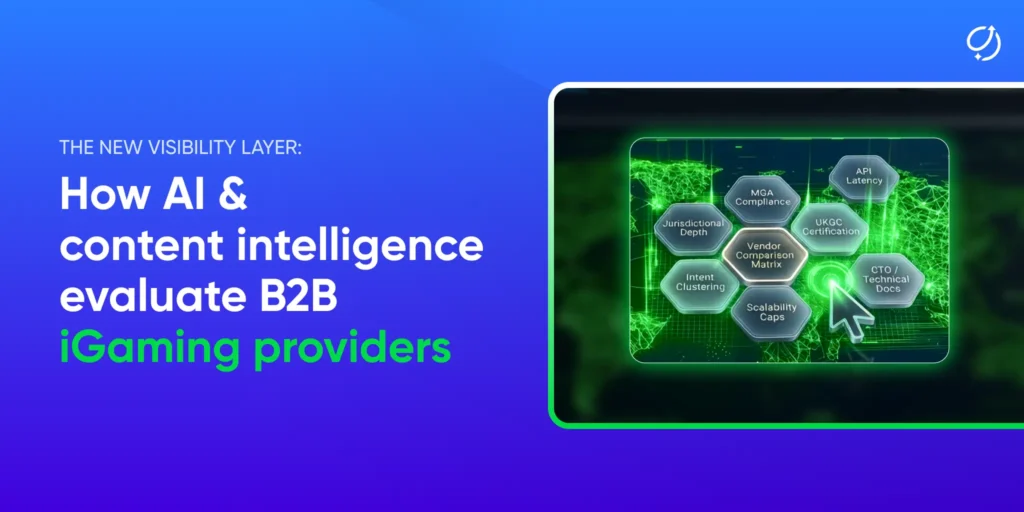
Most B2B iGaming brands believe they are visible. They rank for their core keywords. They publish blogs. They attend events. They sponsor industry portals.
Yet when a query is generated by C-suite buyers on AI search engines, their brand doesn’t appear. The reason is not that they lack capability but because they are structurally absent from AI-generated buying conversations.
This is where AI search & content intelligence becomes commercially critical.
AI Search Has Shifted the Buying Interface
AI-driven search is not just a faster version of Google. It is a simulation layer. Large language models synthesise information, compare vendors, summarise compliance considerations, and structure evaluation criteria before a buyer ever reaches your website. Increasingly, B2B discovery happens inside these summarised outputs.
For iGaming providers, visibility is no longer about ranking for “best iGaming platform provider”. It is about appearing inside AI-generated comparisons, regulatory breakdowns, stack evaluations, and vendor shortlists.
The search has changed, and so has the interface. The decision surface has also seen a shift. And most B2B iGaming brands have not adapted their content architecture to match it.
What AI Search & Content Intelligence Actually Means in iGaming
In B2B iGaming, AI search & content intelligence is not about automating blog production. It is a strategic process of using semantic analysis to map the “Dark Funnel”—the space where buyers ask complex, technical, and compliance-heavy questions that traditional SEO tools fail to capture.
In simple terms, it is about using AI to analyse:
- What real buyers are searching for and asking
- Which questions signal commercial intent
- Where your content has structural gaps
- Where you are cannibalising topics instead of building depth
This involves moving beyond keyword volume and into semantic analysis. In this, there are three distinctive pillars:
- Intent Clustering: Moving beyond keywords to group queries by “commercial friction”. E.g., integration debt, scalability caps, and regulator lag.
- Semantic Group: Identifying where your documentation fails to provide the “structured data” AI models need to recommend to you.
- Entity Authority: Establishing your brand as the definitive source for specific jurisdictional or technical sub-topics.
The output is not “more content”. It is clarity on which decision conversations you are structurally absent from.

For iGaming Marketing Teams Who Want More
Practical tips, trends, strategies, and more.
The Shift: Visibility Now Happens Inside Buying Simulations
The iGaming B2B buyer’s journey has shifted from “discovery” to “validation”. Today, visibility is earned by appearing inside comparative evaluations and stack simulations. AI systems simulate how buyers think. They:
- compare vendors
- outline evaluation criteria
- summarise jurisdiction nuances, and
- suggest integration considerations
This means if your brand doesn’t have structured comparison pages, integration documentation and stack compatibility content, jurisdiction-specific breakdowns (MGA, Curacao, UKGC, etc.), and clear positioning against adjacent competitors, then AI systems have little structured material to reference.
Why Most Brands Miss This
Most B2B iGaming brands miss this because their content is educational and generic. It explains “What is a PAM?” but rarely addresses “How does this PAM compare to X in regulated Tier-1 markets?”
- They optimise for traffic, not evaluation
- They produce explanations, not comparisons
- They generalise compliance instead of structuring it
- They fragment authority across too many shallow pieces
They produce awareness content, but not decision-layer content. Content intelligence shifts the focus toward mapping commercial friction before it happens. It anticipates buyer objections and comparison criteria and builds structured assets around them.
Role-Based Content: Engineering for the Buying Group
B2B iGaming decisions are made by committees: the CTO, Head of Compliance, and the CFO. AI search agents are smart enough to tailor answers based on the persona of the user.
Content intelligence requires creating role-based technical assets:
- For the CTO: API documentation, technical specs, and latency benchmarks.
- For the Compliance Officer: regulatory roadmaps, KYC/AML integration depth, and jurisdictional certifications.
- For the CEO: market entry speed, long-term scalability, and revenue share model.
If your content library only speaks to “General Marketing,” you are failing to provide the specific data points required for multi-departmental buy-in simulation.
Intent Clustering Changes Content Strategy
AI-powered query analysis allows content teams to cluster search behaviour into three broad intent layers:
- Education: “How does iGaming geolocation work?”
- Comparison: “Provider A vs Provider B sportsbook platform”
- Validation: “Is X compliant with UKGC requirements?”
Most B2B iGaming brands overinvest in the first layer. Yet commercial influence often happens in layers two and three. Using AI search analytics and clustering tools, your team can:
- Group queries by intent type
- Map them against buyer journey stages
- Identify high-friction validation topics
- Prioritise fewer, higher-impact content pieces
This creates strategic focus. And instead of publishing ten broad articles, you develop one structured comparison hub, one jurisdiction compliance matrix, and one integration explainer that actually influences vendor evaluation.
How Teams Actually Apply Content Intelligence
Step 1: Extract Real Buyer Queries
Use AI tools (Perplexity, internal search data, sales queries) to gather real comparison and validation questions.
Step 2: Cluster by Intent
Group queries into education, validation, and comparison. Prioritise the high-friction validation topic.
Step 3: Identify Gaps
Map existing content against these clusters. Look for missing comparisons, integration detail, and jurisdiction breakdowns.
Step 4: Build Decision-Layer Asset
Create structured pages for vendor comparisons, integration documentation, and compliance matrices.
Step 5: Make It Machine-Readable
Use clear formatting, structured data, and explicit answers – not narrative-heavy blogs.
This is not a content expansion exercise. It is a content restructuring exercise.
Why Most iGaming Brands Remain Invisible
There are three structural reasons why most iGaming brands remain invisible:
- No decision-layered content – awareness content exists, but structured comparisons and validation pages do not.
- No jurisdiction depth – regulated markets demand specificity. Generic global positioning lacks semantic strength.
- Fragmented content architecture – overlapping blogs dilute authority instead of building consolidated expertise hubs.
AI search rewards clarity, structure, and depth. It does not reward volume.
Practice Over Volume: The New Mandate
The era of the “content treadmill” is over. In 2026, the “less is more” principle is a strategic necessity. Success for iGaming businesses now looks like:
- Less Volume: Fewer blog posts, more high-authority “pillar” assets.
- More Depth: 3000-word technical whitepapers that solve specific migration problems.
- Machine-Readiness: Heavy use of schema markup and structured data to ensure AI agents can “ingest” your value proposition accurately.
Most teams today plan content monthly, track keyword rankings, and optimise for traffic. But the high-performing teams map content to decision stages, track presence in comparison, and validate queries, and optimise for AI citation and inclusion.
As a result, high-performing teams are cutting down low-impact content production while reallocating their effort into 3-5 high-impact assets per quarter, like comparison hubs, compliance matrices, and integration deep-dives.
Content calendars become intelligence-driven rather than volume-driven. Instead of asking, “What should we publish next month?”, the better question becomes, “Which commercial evaluation conversation are we currently absent from?”
AI search & content intelligence is ultimately about strategic presence inside digital buying simulations. Because in B2B iGaming, by the time a prospect fills out a demo form, the shortlist has often already been shaped by an AI system.